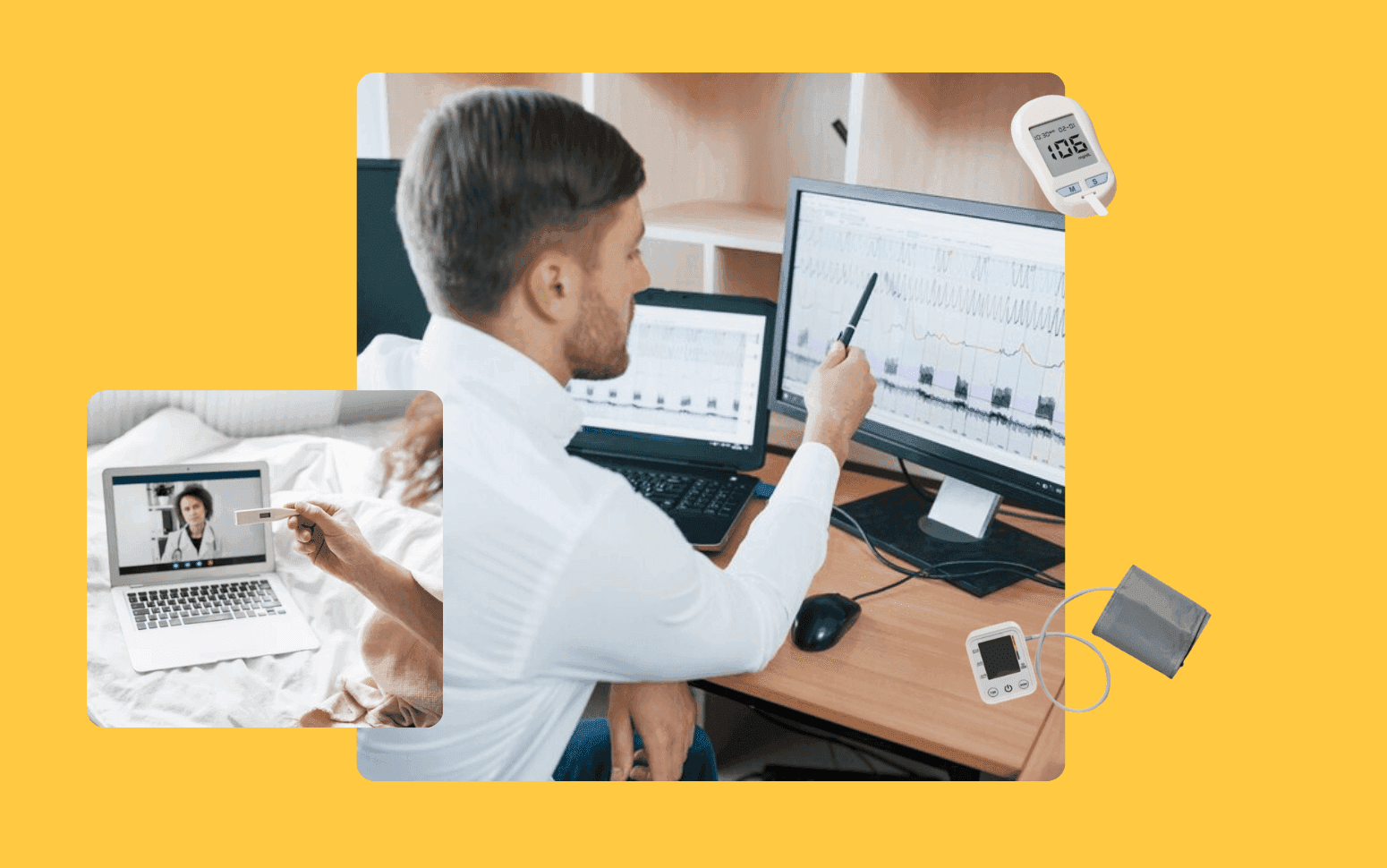
AI Remote Patient Monitoring Cuts Hospital Readmissions
- 30%
- Reduction in hospital readmissions
- 12 weeks
- From scoping to clinical deployment
Read case study
Custom telehealth platforms for primary care practices, FQHCs, and health systems building full-spectrum virtual care workflows.
We build the video infrastructure, EHR write-back, e-prescribing, lab order integration, and chronic care follow-up workflows that a production primary care telehealth platform requires.
HIPAA-compliant video with bidirectional EHR write-back (Epic FHIR R4, Cerner, Athenahealth)
E-prescribing integrated within the consultation workflow, including EPCS for controlled substances
Lab order integration with structured result delivery back to the patient via the telehealth platform
Chronic disease management follow-up with between-visit data collection and automated scheduling
RaftLabs builds primary care telehealth platforms for primary care practices, federally qualified health centres, and health systems. We develop HIPAA-compliant video consultation infrastructure, bidirectional EHR integration (Epic FHIR R4, Cerner Ignite, Athenahealth), e-prescribing, lab order integration with result delivery back to the telehealth platform, and chronic disease management follow-up workflows. Most primary care telehealth platform builds deliver in 12-16 weeks at a fixed cost.
Recognition
Running telehealth visits but writing notes twice, once in the platform and again in the EHR, because your telehealth tool doesn't write structured notes back to Epic or Cerner?
Ordering labs during a telehealth visit but having no way to deliver results back to the patient through the same platform, forcing a separate phone call or patient portal login?
Chronic disease management follow-ups fragmented from the main telehealth workflow, no between-visit data collection, no automated follow-up scheduling, no structured care plan tracking?
Companies we've built for







The failure mode of generic telehealth in primary care isn't the video quality, it's everything that happens before and after the visit. A primary care clinician needs to see the patient's active problem list, current medications, and recent lab results before the call starts. They need to write a structured note that goes directly into the EHR encounter, not a PDF attached to the chart. They need to order labs, generate a prescription, and schedule the patient's next follow-up without leaving the consultation interface.
When those capabilities aren't integrated, clinicians work around the telehealth platform rather than through it: duplicate charting, manual lab coordination, and fragmented follow-up workflows that add administrative time and create clinical gaps in the patient record.
We build primary care telehealth platforms around the full clinical workflow, the EHR is a first-class integration partner, not an afterthought export.
Synchronous video consultation built on WebRTC, with media layer selection (Twilio Video, Daily.co, or AWS Chime SDK) determined by your compliance requirements, session volume, and network environment. All media encrypted end-to-end using DTLS-SRTP. Session metadata encrypted at rest using AES-256. TLS 1.3 for all API communication. BAAs executed with every infrastructure provider that handles PHI.
Waiting room management queues patients before the provider joins, with estimated wait time visible to the patient and patient queue visible to the provider. The pre-session view surfaces the relevant EHR data for the upcoming visit: active medications, relevant diagnoses, recent vitals, and any structured intake data the patient completed before the session. The provider arrives at the consultation already oriented to the patient's clinical context, not opening a second system to review the chart.
Video quality adapts to available bandwidth using simulcast and SFU architecture, scaling from 360p on constrained connections to 720p or 1080p where bandwidth permits. STUN/TURN failover handles corporate firewall and restrictive NAT configurations that block direct peer-to-peer paths. Post-session, the structured SOAP note and any orders or prescriptions generated during the visit write back to the patient's EHR encounter via FHIR R4 before the consultation record closes.
Bidirectional EHR integration using FHIR R4 for Epic, Cerner Millennium, and Athenahealth, not a PDF export, but structured clinical data that the receiving EHR can process programmatically. Before the visit, the platform pulls: FHIR Patient resource for demographics, FHIR Condition resources for the active problem list, FHIR MedicationRequest resources for current medications, FHIR Observation resources for recent vitals, and FHIR DiagnosticReport resources for recent lab results. SMART on FHIR OAuth 2.0 handles authorisation and launch context so the provider doesn't need a separate EHR login.
After the visit, structured clinical data writes back using the EHR's FHIR write APIs where available. For Epic, the post-visit documentation creates a FHIR Encounter resource and a FHIR DocumentReference containing the consultation note in C-CDA format. FHIR MedicationRequest resources record any prescriptions generated. FHIR ServiceRequest resources record any lab orders placed. FHIR Appointment resources create any follow-up appointments scheduled.
For Cerner Millennium, the Ignite FHIR API handles the same resource types with Cerner-specific scopes and configuration. For Athenahealth, the Athenahealth REST API provides the integration surface for patient data and clinical documentation. For legacy systems that predate FHIR, HL7 v2 messaging through an integration engine (Mirth Connect or Azure Health Data Services) handles patient demographic sync, order messaging (ORM), and results delivery (ORU). Integration scope is determined during discovery, the specific EHR version, configuration, and API access determine the implementation path.
Prescribing workflow integrated within the consultation interface, the provider doesn't switch applications mid-visit. During the session, the prescribing interface shows the patient's current medication list pulled from the EHR via FHIR MedicationRequest, formulary lookup with real-time insurance coverage status, and pharmacy selection with the patient's preferred pharmacy pre-populated from the patient record.
Standard prescriptions (non-controlled substances) transmit electronically to the patient's selected pharmacy via Surescripts, the dominant e-prescribing network. Transmission confirmation appears in the provider interface, and the transmitted prescription is recorded against the patient record with the Surescripts transaction ID for audit purposes.
Electronic Prescribing for Controlled Substances (EPCS) for Schedule II-V medications uses DEA-compliant two-factor authentication before each transmission: a knowledge factor (password or PIN) plus either a biometric (Touch ID, Face ID) or a hardware token. Transmission routes through a DEA-registered intermediary (Surescripts or DrFirst) with cryptographic signing. Every EPCS transaction logs the authenticating factors used, the prescribing provider's DEA number, controlled substance details, and transmission timestamp.
Medication reconciliation at each visit compares the platform's current medication list against the EHR's medication list and surfaces discrepancies for provider review. Refill management allows patients to request refills via the patient-facing app, routing the request to the provider for review and transmission without a full consultation.
Lab ordering within the consultation workflow with result delivery back to the patient through the telehealth platform, closing the loop that most telehealth tools leave open. During the session, the provider accesses the lab ordering interface, selects tests from the compendium for your reference lab (Quest Diagnostics, LabCorp, or your health system's internal lab), specifies the order priority, and submits. The lab order transmits as a FHIR ServiceRequest to the ordering system and simultaneously writes back to the patient's EHR chart.
Patients receive the lab order details via the patient-facing app: which tests were ordered, where to go for collection (nearest in-network collection site based on the patient's location), and what preparation is required (fasting, timing). Collection site lookup uses the lab's location API to surface the nearest facilities.
When results are available, they transmit back to the platform as FHIR DiagnosticReport resources (or HL7 v2 ORU R01 messages for legacy lab systems) and are made available to the provider in the patient record. The provider reviews results, adds a clinical interpretation note, and releases results to the patient through the telehealth platform. Abnormal results trigger a provider notification for review before results are released to the patient, so patients don't receive critical abnormal values without clinical context. Result release creates an audit event and a patient notification.
Between-visit workflows for patients managed for chronic conditions, hypertension, type 2 diabetes, COPD, heart failure, hypothyroidism, where clinical management depends on data collected between scheduled visits, not just at the point of consultation.
Structured follow-up protocols are configured per condition. A hypertension protocol might require weekly blood pressure readings submitted via the patient app, with alert thresholds configured at the practice level and individual patient overrides for high-risk patients. A diabetes protocol might require daily fasting glucose readings with medication adherence confirmation. Readings submitted through the patient app store as FHIR Observation resources against the patient record. Care managers monitor the follow-up queue for patients with missed submissions or out-of-threshold readings.
Automated follow-up scheduling generates appointment reminders at the intervals specified in the care plan: a 4-week follow-up for a new hypertension medication, a 3-month HbA1c follow-up for a stable diabetic patient, or a 2-week follow-up for an acute issue that resolved. Appointment reminders route through the patient-facing app and SMS. Follow-up visit notes reference the between-visit data collected since the last appointment, so the provider arrives at the follow-up with a summary of readings and adherence data already prepared. Chronic disease programme outcomes, blood pressure control rates, HbA1c distribution across the panel, follow-up completion rates, are available in the practice analytics dashboard.
Patient-facing iOS and Android apps for the full telehealth workflow, appointment booking, pre-visit intake, video session, post-visit instructions, lab result access, prescription status, and between-visit data submission. Appointment booking integrates with the practice's scheduling system or the platform's own scheduling interface, with availability shown in real time and confirmation delivered via push notification and email.
Pre-visit intake collects structured information before the session: chief complaint, symptom duration and character, current medications (patient self-reported, reconciled against the EHR medication list), and relevant history for the presenting concern. For chronic disease follow-up visits, the intake includes current readings for the relevant monitored parameters and any changes in symptoms since the last visit.
Biometric authentication (Face ID, Touch ID, Android BiometricPrompt API) for returning users maintains the authentication audit trail HIPAA requires. Push notifications use APNs (iOS) and FCM (Android) for appointment reminders, provider messages, and result notifications, with clear clinical rationale in the permission request to improve opt-in rates. VoiceOver (iOS) and TalkBack (Android) accessibility is built in from the start; WCAG 2.1 AA is a baseline requirement for a primary care app whose patient population includes older adults and patients with visual impairments.
A focused primary care telehealth MVP, HIPAA-compliant video, EHR read integration for pre-session chart review, e-prescribing, and patient and provider web interfaces, typically runs $50,000--$90,000 and delivers in 12--16 weeks. That scope covers encrypted video infrastructure, pre-session EHR data pull, standard (non-controlled) e-prescribing via Surescripts, audit logging, and BAA setup with your cloud provider.
A full-featured platform with bidirectional EHR write-back (Epic FHIR R4 or Cerner Ignite), EPCS for controlled substances, lab order integration with result delivery, chronic disease management follow-up workflows, and patient iOS and Android apps typically runs $100,000--$200,000. The primary cost drivers are EHR integration depth (read-only vs. full bidirectional write-back), EPCS compliance, lab integration complexity, and the number of chronic disease protocols to configure. We scope every project before pricing it.
EHR write-back means the telehealth platform transmits structured clinical data back to the patient's EHR after each visit, creating the encounter record, posting the consultation note, recording any prescriptions generated, and logging any orders placed, without the provider having to manually enter this information a second time.
Without write-back, clinicians document the visit in the telehealth platform and then re-enter the same information into the EHR. This duplicate charting adds 10-20 minutes per visit of administrative time, introduces transcription errors, and creates gaps in the patient's longitudinal record when the telehealth summary and the EHR encounter don't match. With structured write-back, the EHR encounter is the single source of truth, and the telehealth platform is the capture interface.
Write-back requires the EHR's FHIR write API to be available and scoped for the data types you need to write. Epic's FHIR R4 API supports write for Encounter, DocumentReference, MedicationRequest, and ServiceRequest resources under specific App Orchard review and integration approval. Cerner Ignite similarly supports FHIR write for core clinical resources. The specific write scope available determines what can be automated vs. what still requires manual EHR action. We define this scope during discovery rather than assuming full write-back is available, the difference matters significantly for scoping and timeline.
Lab order integration creates a direct connection between the telehealth consultation and your reference lab's ordering system. During the session, the provider places a lab order from within the telehealth interface. The order transmits to the reference lab (Quest, LabCorp, or a health system lab) as a FHIR ServiceRequest or HL7 ORM message, depending on the lab's integration interface. The order simultaneously writes to the patient's EHR chart as a pending order.
The patient receives the order details and collection site information through the patient app. When results are available, they transmit back to the platform as a FHIR DiagnosticReport or HL7 ORU message. The provider reviews, interprets, and releases results to the patient through the same platform the consultation happened on. This closes the loop that most telehealth setups leave open: the patient doesn't have to log into a separate lab portal, and the provider doesn't have to make a separate phone call to deliver results.
The integration approach depends on the lab. Quest and LabCorp both support electronic ordering and results delivery through their provider interfaces. Health system labs vary significantly, some expose FHIR endpoints, others use HL7 v2, others require a direct interface with the lab information system (LIS). We validate the integration path for your specific lab during discovery.
The chronic disease follow-up workflow has three components. First, between-visit data collection: patients submit structured readings (blood pressure, blood glucose, weight, pulse oximetry) via the patient app at the frequency specified in their care plan. Readings store as FHIR Observation resources against the patient record. Second, care team monitoring: a care manager dashboard surfaces patients with missed submissions, out-of-threshold readings, or approaching follow-up dates. Alert thresholds are configurable per condition protocol and per patient. Third, automated follow-up scheduling: the care plan specifies follow-up intervals, and the system generates appointment reminders and, where configured, self-service rebooking links at the appropriate intervals.
The specific conditions, monitoring parameters, threshold values, and follow-up intervals are configured during implementation based on your practice's clinical protocols. We don't impose a generic protocol, the platform is designed to reflect the care protocols your clinical team has already defined. The outputs of the follow-up programme (submission adherence rates, threshold event rates, follow-up completion rates) are available in the practice analytics dashboard so you can evaluate programme performance.
What clients say
Three-year average engagement. Founders and operators describing the work in their own words. No marketing varnish.

 USA
USAAll of the sprints were completed on schedule and on budget. We highly recommend RaftLabs!
Tell us your EHR environment, your patient population, and the clinical workflows you need to support, chronic disease, acute visits, or both. We'll scope the build.