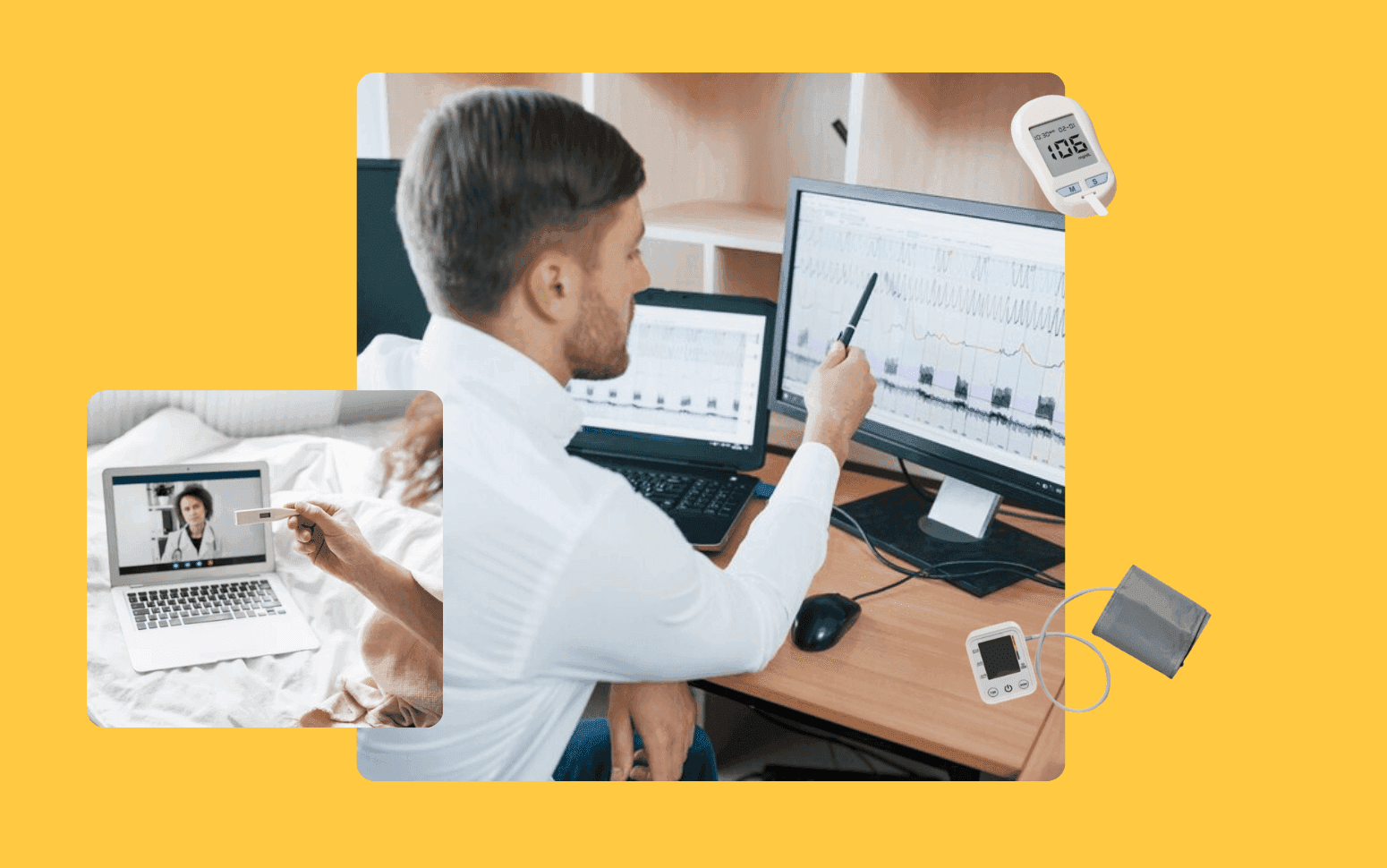
AI Remote Patient Monitoring Cuts Hospital Readmissions
- 30%
- Reduction in hospital readmissions
- 12 weeks
- From scoping to clinical deployment
Read case study
Custom telepsychiatry platforms for behavioural health practices and digital mental health companies building HIPAA-compliant virtual care workflows.
We build the video infrastructure, validated outcome measure integration, secure messaging, and prescription workflows that a production telepsychiatry platform requires.
HIPAA-compliant video with encrypted sessions, waiting room management, and audit logging
Validated outcome measures (PHQ-9, GAD-7, PCL-5, MDQ) embedded in pre-session intake and session workflows
Group therapy video infrastructure with up to 20 concurrent participants and facilitator controls
Prescription management integrated within the session workflow, including EPCS for controlled substances
RaftLabs builds telepsychiatry platforms for behavioural health practices, digital mental health companies, and health systems. We develop HIPAA-compliant video consultation infrastructure, validated outcome measure integration (PHQ-9, GAD-7, PCL-5, MDQ), secure provider-to-patient messaging, group therapy video capabilities, and prescription management workflows connected to the telehealth session. Most telepsychiatry platform builds deliver in 12-16 weeks at a fixed cost.
Recognition
Using a general video platform that has no way to administer PHQ-9, GAD-7, or PCL-5 during or before the session, leaving providers to collect outcome data manually and enter it separately into the EHR?
No infrastructure for group therapy sessions in your telehealth platform, meaning group programmes run on consumer video tools that don't meet HIPAA requirements?
Prescription workflows completely disconnected from the telehealth session, forcing psychiatrists to switch systems mid-consultation to generate and transmit controlled substance prescriptions?
Companies we've built for







The specific failure mode of general telehealth platforms in psychiatry is that they handle the video but nothing else. Psychiatrists need validated outcome measures collected and scored before they open the case. They need group therapy infrastructure that meets HIPAA requirements, not a consumer video call with patients on it. And they need to generate and transmit prescriptions, including controlled substance prescriptions under DEA EPCS requirements, without switching applications mid-session.
We build telepsychiatry platforms around these clinical requirements. The outcome measures feed into the provider's session view with scores already calculated. The group therapy rooms have facilitator controls appropriate to clinical settings. And the prescription workflow lives inside the platform, not in a separate tab.
Synchronous video consultation infrastructure built on WebRTC, evaluated against Twilio Video, Daily.co, and AWS Chime SDK based on your compliance requirements and session volume before selecting the media layer. All media is encrypted end-to-end using DTLS-SRTP; session metadata is encrypted at rest using AES-256. TLS 1.3 for all API communication. Business Associate Agreements executed with every infrastructure provider that handles PHI, the video provider, cloud host, and notification service.
Waiting room management holds patients in a HIPAA-compliant pre-session queue before the provider joins, so patients never see each other's presence in the waiting area, a material difference from general video tools where participants can see the waiting room list. The patient enters the waiting room from a unique session link; the provider joins when ready. Patient-visible waiting room state shows only that they're connected and waiting.
Session recording requires explicit patient consent captured before recording begins, stored as a timestamped consent event against the patient record, this is a HIPAA requirement for any recorded PHI. Multi-party sessions support supervisor participation (for supervised clinical hours), family sessions, and emergency contacts with role-specific access. Provider availability is managed through the platform's scheduling interface or synced from external scheduling systems (Acuity, Calendly) via API. Post-session clinical notes write back to the patient's EHR encounter record via FHIR R4 DocumentReference.
PHQ-9, GAD-7, PCL-5, MDQ (Mood Disorder Questionnaire), and other validated psychiatric instruments embedded directly in the clinical workflow, not as an afterthought form, but as structured data that appears in the provider's session view with scores already calculated before the consultation begins.
Pre-session intake administers the relevant screening instruments based on the appointment type and the patient's diagnosed conditions. A depression follow-up visit triggers a PHQ-9 automatically; a PTSD assessment triggers a PCL-5; an initial adult psychiatric evaluation runs a broader battery configured by the practice. Patients complete the instruments from the patient app or a browser link before joining the session. Scores are calculated on submission and displayed in the provider dashboard alongside prior scores for the same patient, so trend data is visible without manual chart review.
Scores are stored as FHIR Observation resources with the appropriate LOINC code for each instrument (LOINC 44249-1 for PHQ-9 total score, LOINC 70274-6 for GAD-7 total score) so they can be exported to the EHR in a structured format that receiving systems can read programmatically. The provider can administer additional instruments mid-session from the session interface if the clinical presentation warrants it, the patient receives the questionnaire link in the session chat, completes it in a separate window, and the score populates in the provider's view within seconds.
Group therapy video rooms built for the clinical context of psychiatric group treatment, not adapted from consumer video. Groups support up to 20 concurrent participants with facilitator controls that match the clinical role of the group therapist: muting individual participants, removing participants, controlling who can unmute themselves, and creating breakout pairs for dyadic exercises within a group session.
Participant management distinguishes between clinical roles: the facilitating therapist has full moderator controls; co-therapists or trainees have secondary controls; group members have participant-only access. Waiting room management for groups prevents early arrivals from accessing the group space until the facilitator opens the session. Group membership is configured by the clinical team, and join links are unique per participant per session so membership is enforced, patients can't share links to add unregistered participants.
Group session documentation generates a facilitator session note template that includes attendance, session content, individual participant observations, and treatment plan implications. Attendance tracking is automatic: the platform records which participants joined, at what time, and for how long, generating the documentation that supports billing for group psychotherapy (CPT 90853 for group therapy, 90849 for multiple family group therapy). All group session data, including participant video, is governed by the same HIPAA technical safeguards as individual sessions.
HIPAA-compliant secure messaging between providers and patients, built on end-to-end encrypted storage with configurable retention policies meeting the 7-year minimum for adult psychiatric PHI. Messages are stored with full audit logging: sent, read, and deleted events each generate an audit record with timestamp, user identity, and IP address.
Messaging supports structured attachments, care plan documents, psychoeducation materials, homework assignments, safety planning documents, alongside free-text messages. Safety planning is a specific workflow: the provider creates a safety plan document within the messaging interface, the patient reviews and acknowledges it, and the acknowledged version is stored against the patient record as a clinical document with the patient's digital confirmation timestamp. This creates the documentation that clinical governance and risk management processes require.
Provider-to-provider messaging handles care coordination: consultation requests to other providers on the platform, care transition handoffs, and supervision communication. All provider-to-provider messaging about specific patients is governed by the same PHI access controls as clinical records, only providers with an active care relationship with the patient can message about them. Out-of-hours message handling configures automated responses and on-call routing for urgent patient messages received outside clinical hours.
Prescription workflow integrated within the telepsychiatry session, not in a separate application. During the session, the provider accesses the prescribing interface from the consultation dashboard: current medication list (pulled from the patient's EHR via FHIR MedicationRequest), formulary lookup with insurance-specific coverage status, dose and frequency entry, and pharmacy selection. Prescriptions generate and transmit to the patient's selected pharmacy from within the platform without the provider leaving the session interface.
Electronic Prescribing for Controlled Substances (EPCS) compliance for Schedule II-V medications uses DEA-compliant two-factor authentication (knowledge factor plus either a biometric or a hardware token) before transmission. EPCS transmission routes through a DEA-registered intermediary (Surescripts, DrFirst) that handles the cryptographic signing and transmission requirements. The platform logs the two-factor authentication event, the prescribing identity, and the transmitted prescription against the patient record for the DEA audit trail.
Refill management within the platform handles routine refill requests without requiring a full consultation: the patient requests a refill via the messaging interface, the provider reviews the request, and the refill is transmitted from the same prescribing workflow. Medication reconciliation at each consultation compares the platform's medication list against the EHR's current medication list and flags discrepancies for provider review.
HIPAA technical safeguard implementation with specific attention to the privacy requirements of behavioural health data. 42 CFR Part 2 (Substance Use Disorder records) imposes more restrictive disclosure requirements than standard HIPAA; where a practice treats patients for substance use disorder alongside psychiatric conditions, the platform's data model and access control architecture must handle the more restrictive standard for substance use records. We design access control and data segmentation to support 42 CFR Part 2 compliance where your practice requires it.
State mental health privacy laws (California Welfare and Institutions Code 5328, for example) impose disclosure restrictions beyond HIPAA on specific categories of psychiatric records. Where your practice operates across multiple states, we map the applicable state-level privacy requirements during discovery and ensure the platform's consent and disclosure workflow handles them correctly.
Minimum necessary access control applies role-based restrictions aligned to clinical relationships: a prescribing psychiatrist sees the full medication history; a therapist without prescribing privileges sees clinical notes but not controlled substance prescribing detail; administrative staff with billing access see scheduling and billing data without clinical notes. Role assignments are configured per user and audited. Crisis intervention documentation, safety plans, emergency contact activations, emergency services contacts, is flagged in the patient record with the provider's clinical justification, creating the audit trail that risk management requires.
A focused telepsychiatry MVP, HIPAA-compliant video, pre-session PHQ-9/GAD-7 intake with automated scoring, secure messaging, and basic prescription management, typically runs $50,000--$90,000 and delivers in 12--16 weeks. That scope covers encrypted video infrastructure, validated outcome measure administration, audit logging, BAA setup with your cloud provider, and patient and provider web interfaces.
A full-featured platform with group therapy infrastructure, EPCS for controlled substances, EHR integration (FHIR R4 for Epic or similar), 42 CFR Part 2 data segmentation, multi-state privacy compliance, and automated CPT billing support typically runs $90,000--$180,000. The primary cost drivers are group therapy room complexity, EPCS compliance (the two-factor authentication and DEA-registered transmission pathway adds significant scope), EHR integration depth, and multi-state regulatory requirements. We scope every project before pricing it.
We implement any validated psychiatric instrument where a structured questionnaire exists: PHQ-9 (depression), PHQ-2 (depression screening), GAD-7 (generalised anxiety), PCL-5 (PTSD), MDQ (Mood Disorder Questionnaire for bipolar screening), AUDIT-C (alcohol use), DAST-10 (drug use), CAGE-AID (substance use), Columbia Suicide Severity Rating Scale (C-SSRS), and condition-specific instruments used in your practice.
Instruments are administered as structured questionnaires with the validated response options for each item. Scoring is automated per the validated scoring algorithm for each instrument, PHQ-9 total score with severity classification (none, mild, moderate, moderately severe, severe), GAD-7 total score with severity classification, PCL-5 total score against the diagnostic threshold. Scores are stored as FHIR Observation resources with LOINC codes for structured EHR export. Prior scores for the same patient and instrument are displayed as a trend alongside the current score in the provider's session view.
Electronic Prescribing for Controlled Substances (EPCS) is a DEA requirement for electronically prescribing Schedule II-V medications. EPCS requires two-factor authentication before each controlled substance prescription is transmitted: the prescribing provider must authenticate using a knowledge factor (password or PIN) and either a biometric (Touch ID, Face ID, or equivalent) or a hardware token (FIDO2 device or one-time passcode generator). Both factors must be present at the point of prescribing, the session token from login isn't sufficient.
Transmission routes through a DEA-registered intermediary. We integrate with Surescripts or DrFirst, both of which hold DEA registration as Prescription Drug Monitoring Program (PDMP)-integrated transmission networks. The platform's EPCS workflow handles the two-factor prompt, captures the cryptographic signing event, and transmits through the registered intermediary. Every EPCS transmission is logged with the authenticating factors used, the prescribing provider's DEA number, the controlled substance details, and the transmission timestamp, the audit trail the DEA requires. We work with your legal and compliance team during implementation to confirm that your practice's specific controlled substance workflows (which Schedules you prescribe, telemedicine prescribing rules under the Ryan Haight Online Pharmacy Consumer Protection Act) are handled correctly.
Yes, but it requires purpose-built infrastructure. Consumer video tools (Zoom, Teams, Google Meet) don't meet HIPAA requirements for clinical group therapy because most don't offer BAAs that cover all the data their platforms process, and the participant controls available in consumer tools don't match the clinical requirements of group therapy facilitation.
A HIPAA-compliant group therapy room requires: a BAA with the video infrastructure provider; end-to-end encrypted media for all participants; waiting room management that prevents participants from seeing each other before the facilitator opens the session; facilitator-only controls for muting and removing participants; unique, non-shareable join links per participant per session; and audit logging of session participation. The platform architecture also needs to handle the consent requirements for group therapy, each participant's consent to receive treatment in a group format and to the recording policy, if recording is used, must be captured and stored.
What clients say
Three-year average engagement. Founders and operators describing the work in their own words. No marketing varnish.

 USA
USAAll of the sprints were completed on schedule and on budget. We highly recommend RaftLabs!
Tell us your clinical programme structure, individual, group, or both, your prescribing requirements, and your current EHR environment. We'll scope the build.