Your chatbot is routing everything to a human agent because it can't handle anything complex?
Users abandoning the chat widget because the bot gives generic answers?
AI Chatbot Development Company
Most businesses need an AI chatbot development company that builds for outcomes, not demos. Generic chatbots answer simple questions badly. They frustrate users, get escalated to humans for everything non-trivial, and end up switched off within a month. The problem isn't chatbots -- it's chatbots that aren't trained on your product, your policies, and your customers' actual questions. We build AI chatbots grounded in your knowledge -- trained on your documentation, your support history, and your business logic. Chatbots that resolve real queries, not just deflect them. Our deployments handle 50,000+ monthly conversations and resolve 60--80% of routine queries without human handoff.
Trained on your product docs, policies, and support history
Resolves real queries -- not just FAQ lookups
Integrated with your helpdesk, CRM, or product backend
Fixed project cost -- scoped and priced before we start
Why most chatbots get switched off
The failure pattern is always the same: the chatbot was built to handle simple FAQs. Users ask one level deeper -- "what does that actually mean for my account?" -- and the bot says "I don't know, let me connect you to a human." The human agent answers it in 30 seconds. Users learn to skip the bot entirely.
The fix isn't more FAQs. It's grounding the chatbot in your actual product knowledge -- the documentation, the policy documents, the support tickets that already contain the answers. A well-built AI chatbot can handle 60--80% of queries end-to-end, including follow-ups, because it understands context, not just keywords.
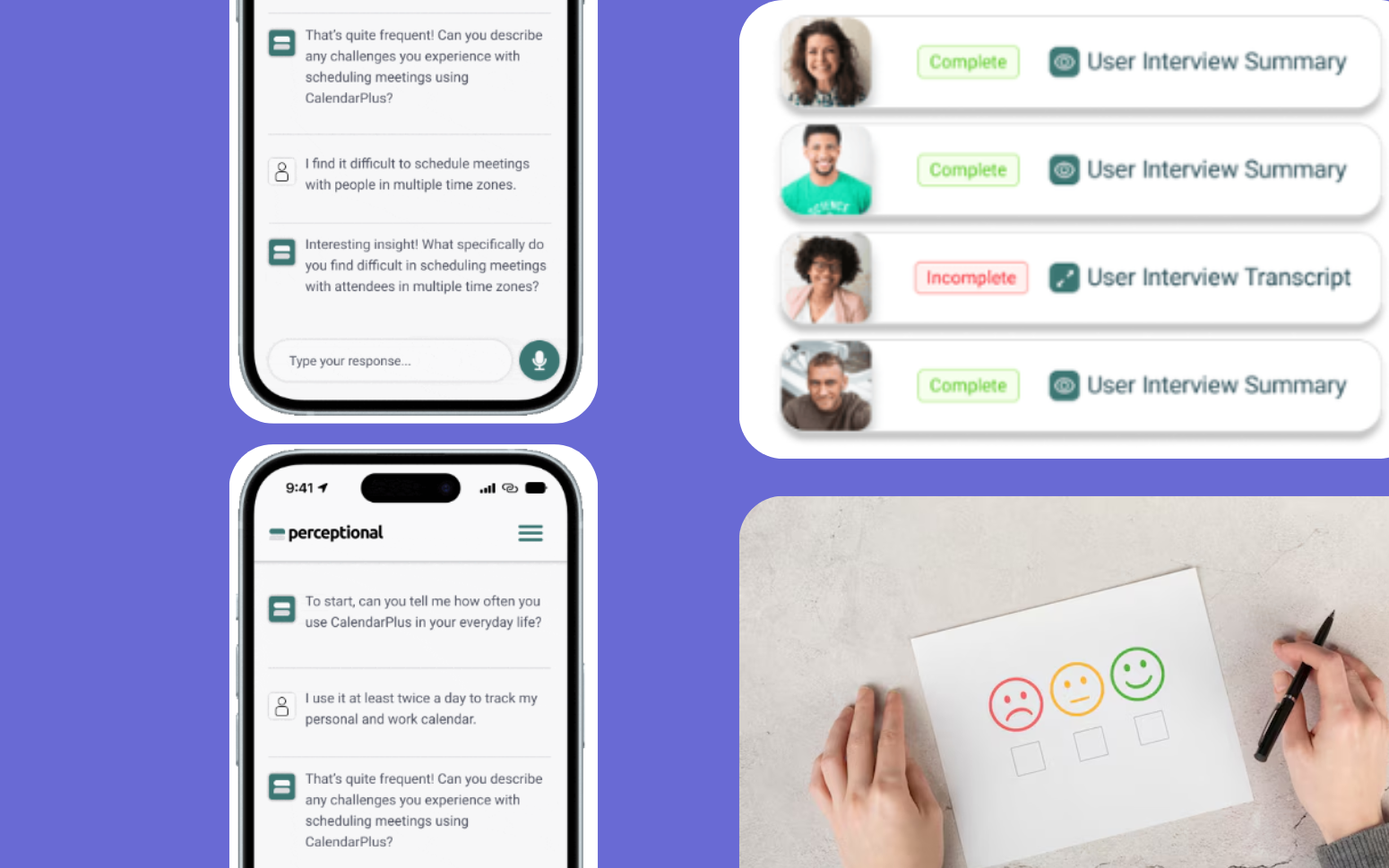
We've built chatbots for customer support, internal IT helpdesks, product onboarding, and HR query management -- handling 50,000+ monthly conversations across deployments. For Perceptional, a conversational AI chatbot we built replaced traditional surveys: 4x deeper insights, 48-hour time to actionable findings, launched in 12 weeks. In every case, the chatbot's accuracy is only as good as the quality of the knowledge it's grounded in. We spend more time on the knowledge architecture than on the interface.
Need ChatGPT API integration for an existing product instead of a full custom build? See our ChatGPT API integration service.
What we build
Customer support chatbots
Chatbots that resolve product queries, account questions, billing issues, and policy lookups without involving a human agent. Trained on your help docs, support tickets, and product knowledge. Integrated with your helpdesk for escalation with full context.
Internal knowledge assistants
Internal chatbots for IT helpdesks, HR queries, and operational procedures. Employees get instant answers from company policies, runbooks, and internal documentation -- without waiting for a colleague or searching through a wiki.
Product onboarding chatbots
Chatbots that guide new users through setup, answer feature questions, and surface the right documentation at the right moment in the user journey. Reduces time-to-value and support ticket volume from new users.
Sales and lead qualification bots
Conversational bots that qualify inbound leads, answer pre-sales questions, book discovery calls, and route qualified prospects to your sales team with a summary of the conversation and the prospect's stated needs.
Multilingual chatbots
Chatbots that serve users in multiple languages -- detecting language automatically and responding in kind. Built for businesses serving international customers without separate regional support teams.
Voice-enabled chatbots
Chatbots with voice input and output for hands-free interaction -- embedded in call centre flows, IVR replacements, and mobile apps where text input is inconvenient. See also: AI voicebot development.
What does your chatbot need to actually resolve?
Tell us the query types and the knowledge sources. We'll design the architecture and give you a fixed cost.
We start by mapping your knowledge sources -- what your chatbot needs to know and where that information lives. This shapes the retrieval architecture and determines accuracy before a line of interface code is written.
Accuracy testing before launch
We test every chatbot against a set of real queries from your support history before going live. We measure accuracy, identify knowledge gaps, and fill them before the chatbot sees real users.
Monitored post-launch
We monitor chatbot performance after launch -- tracking escalation rates, accuracy on edge cases, and user satisfaction. The chatbot improves over time as we identify and fix failure modes.
What clients say
What our clients say
Three-year average engagement. Founders and operators describing the work in their own words. No marketing varnish.
Amer Abu Khajil
Founder, Peak Studios & Perceptional
Canada
“
“I found RaftLabs to be the perfect partner for Perceptional, with their expertise in helping startup founders build MVPs, a free consultation, a prototype that matched my vision, and their unwavering support.”
Tell us what users ask and where the answers live. We'll design the system and give you a fixed cost.
Proof of Concept: Working chatbot demo in 2 weeks.
Zero-Obligation: Walk away in 14 days if unsatisfied.
Milestone Pricing: Pay as you go, no surprises.
Frequently asked questions
AI chatbot development is the process of designing, building, and deploying a conversational interface powered by large language models (LLMs) and natural language processing. Unlike rule-based bots that match keywords to pre-written responses, an AI chatbot understands the meaning of a question -- even if phrased in unexpected ways -- and generates a contextually accurate response. It holds context across a conversation, handles follow-up questions, and escalates to a human agent when it cannot resolve an issue. A full development engagement covers conversational design, knowledge architecture, LLM selection, RAG pipeline setup, integration with your existing systems, accuracy testing, and post-launch monitoring.
A chatbot answers questions. A conversational AI agent takes action. A chatbot retrieves information from a knowledge base and responds -- it is reactive. An AI agent can execute multi-step tasks autonomously: look up an order, issue a refund, update a CRM record, and send a confirmation email -- all within a single conversation. Most businesses start with a chatbot for customer support or internal knowledge retrieval. They move to an agent when the use case requires the bot to complete transactions, not just answer questions. See our AI agent development service for agentic builds.
It depends on the primary use case. Customer support chatbots handle product queries, billing questions, and policy lookups -- they reduce ticket volume and support headcount pressure. Sales and lead qualification chatbots work 24/7 to qualify inbound leads, answer pre-sales questions, and book discovery calls. Internal ops chatbots serve IT helpdesks, HR queries, and knowledge retrieval for employees. Voice AI chatbots handle phone and IVR channels where text input is impractical. If you have a single high-volume use case, start with a focused single-channel build ($20,000--$45,000). If you need omnichannel coverage or enterprise integrations, plan for a multi-channel build ($50,000--$120,000).
Cost depends on complexity tier. A focused single-channel chatbot (one use case, one channel, RAG-grounded) typically runs $20,000--$45,000. A multi-channel enterprise chatbot with custom integrations, escalation logic, and analytics dashboards typically runs $50,000--$120,000. The main cost drivers are: number of knowledge sources to index, number of channels (web, WhatsApp, Slack, Teams, voice), depth of CRM and helpdesk integration, and whether custom LLM fine-tuning is required. We scope every project before pricing it -- no surprises.
A focused chatbot for a single use case -- customer support, internal IT helpdesk, or product onboarding -- typically takes 6--10 weeks from kickoff to production. A multi-channel chatbot with enterprise integrations, custom escalation logic, and analytics dashboards takes 12--16 weeks. We build a working demo in the first 2 weeks so you can test accuracy before committing to the full build.
We build on GPT-4o (OpenAI), Claude 3.5 (Anthropic), Llama 3 (Meta, for on-premises deployments), and Mistral. LLM selection depends on your accuracy requirements, data residency constraints, and cost targets. We use a retrieval-augmented generation (RAG) architecture in most deployments -- the LLM generates responses from your knowledge base, not from its general training data. This gives you accuracy and reduces hallucination risk. We are model-agnostic: we recommend the right model for your use case, not the one that is easiest for us to deploy.
Four patterns cause most failures. First: no human fallback design. The chatbot hits an edge case it cannot handle, leaves the user stuck, and the user abandons. Every chatbot needs clear escalation paths with confidence thresholds. Second: thin knowledge base at launch. If the chatbot is not grounded in your actual product documentation and support history, it cannot answer anything beyond generic FAQs. Third: measuring vanity metrics instead of deflection rate. Session count and message volume tell you nothing. The only metric that matters is the percentage of queries resolved without human handoff. Fourth: vendor lock-in. Proprietary chatbot platforms own your data and charge for every API call. We build on infrastructure you control and hand over everything at project end.
We deploy on web (embedded chat widget), mobile apps (iOS and Android via SDK), WhatsApp, Slack, Microsoft Teams, and custom API integrations. The same chatbot backend can serve multiple surfaces. For helpdesk integration, we connect with Zendesk, Intercom, Freshdesk, and ServiceNow -- human escalations land in the right queue with full conversation context. For CRM integration, we connect with Salesforce, HubSpot, and Pipedrive so lead data from sales chatbots flows directly into your pipeline. We also integrate with internal tools: Confluence, Notion, SharePoint, and custom internal wikis as knowledge sources.














 Canada